A Defence of Nonsense
- The matters which most thoroughly evoke this sense of the abiding childhood of the world are those which are really fresh, abrupt and inventive in any age; and if we were asked what was the best proof of this adventurous youth in the nineteenth century we should say, with all respect to its portentous sciences and philosophies, that it was to be found in the rhymes of Mr. Edward Lear and in the literature of nonsense. 'The Dong with the Luminous Nose,' at least, is original, as the first ship and the first plough were original.
- It is true in a certain sense that some of the greatest writers the world has seen—Aristophanes, Rabelais and Sterne—have written nonsense; but unless we are mistaken, it is in a widely different sense. The nonsense of these men was satiric—that is to say, symbolic; it was a kind of exuberant capering round a discovered truth. There is all the difference in the world between the instinct of satire, which, seeing in the Kaiser's moustaches something typical of him, draws them continually larger and larger; and the instinct of nonsense which, for no reason whatever, imagines what those moustaches would look like on the present Archbishop of Canterbury if he grew them in a fit of absence of mind. We incline to think that no age except our own could have understood that the Quangle-Wangle meant absolutely nothing, and the Lands of the Jumblies were absolutely nowhere. We fancy that if the account of the knave's trial in 'Alice in Wonderland' had been published in the seventeenth century it would have been bracketed with Bunyan's 'Trial of Faithful' as a parody on the State prosecutions of the time. We fancy that if 'The Dong with the Luminous Nose' had appeared in the same period everyone would have called it a dull satire on Oliver Cromwell.
- … Religion has for centuries been trying to make men exult in the 'wonders' of creation, but it has forgotten that a thing cannot be completely wonderful so long as it remains sensible. So long as we regard a tree as an obvious thing, naturally and reasonably created for a giraffe to eat, we cannot properly wonder at it. It is when we consider it as a prodigious wave of the living soil sprawling up to the skies for no reason in particular that we take off our hats, to the astonishment of the park-keeper. Everything has in fact another side to it, like the moon, the patroness of nonsense. Viewed from that other side, a bird is a blossom broken loose from its chain of stalk, a man a quadruped begging on its hind legs, a house a gigantesque hat to cover a man from the sun, a chair an apparatus of four wooden legs for a cripple with only two.
Words to know
- evoke C1
- bring a feeling or memory into the mind — hervorrufen, heraufbeschwören — evocar — évoquer — rammemorare — wywołać, wywoływać, przywołać — evocar — вызывать, вызвать — almak, elde etmek, öğrenmek — викликати, звати, кликати
- portentous
- very serious and rather self-important
- satiric
- using humour to criticise people or ideas
- exuberant C1
- full of energy, joy and excitement — überschwänglich, ausgelassen, lebendig — exuberante — exubérant — entuzjastyczny, bujny — exuberante — энергичный, неудержимый, бурный — енергійний, енергетичний
- parody
- a funny imitation that mocks something — Parodie — parodia — parodie — parodia — paródia — пародия — parodi — пародія
- exult
- feel and show great joy — jubeln, jauchzen — exultar — exulter — esultare — exultar — ликовать, торжествовать
- prodigious
- remarkably great or impressive
- quadruped
- an animal that walks on four legs
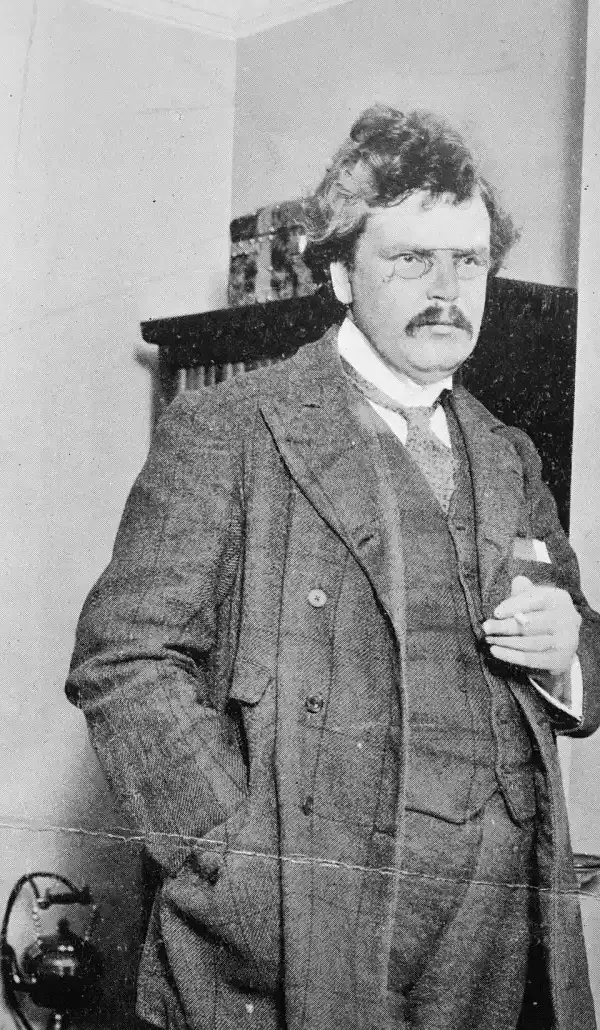
Text: The Defendant (1901), “A Defence of Nonsense”, G. K. Chesterton (1901), https://en.wikipedia.org/wiki/G._K._Chesterton · Public domain (https://creativecommons.org/publicdomain/mark/1.0/) · shortened · Picture: Bain News Service, publisher, Public domain (https://creativecommons.org/publicdomain/mark/1.0/), https://commons.wikimedia.org/wiki/File:G.K._Chesterton_LCCN2014686602_(cropped).jpg · Translations: English Wiktionary contributors, CC BY-SA 4.0 (https://creativecommons.org/licenses/by-sa/4.0/) · Worksheet: https://krumeto.com/read/a-defence-of-nonsense
A. Choose the right answer
- What is the main claim of this excerpt? C2
- a) Nonsense is simply an old kind of satire under a new name.
- b) Nonsense is a genuinely new kind of literature that can renew our sense of wonder.
- c) Science has made poetry and nonsense unnecessary.
- d) Religion and nonsense are natural enemies.
- According to paragraph 2, how does nonsense differ from satire? C2
- a) Satire is written for children, nonsense for adults.
- b) Satire uses rhyme, while nonsense uses prose.
- c) Satire exaggerates something real to make a point; nonsense invents for no reason at all.
- d) Nonsense attacks politicians more directly than satire.
- Why does the writer imagine 'Alice in Wonderland' being published in the seventeenth century? C2
- a) To prove that Carroll copied Bunyan
- b) To suggest that the book is older than people think
- c) To show that it would have been banned
- d) To show that earlier readers would have searched it for a hidden political meaning
- What is the writer's attitude to the "portentous sciences and philosophies" of the nineteenth century? C2
- a) Politely ironic: he respects them but finds nonsense fresher
- b) Confused: he admits he does not understand them
- c) Enthusiastic: they are the best proof of the age's youth
- d) Openly hostile: he thinks they did real harm
- In paragraph 3, a thing cannot be wonderful "so long as it remains sensible". Here "sensible" means… C2
- a) able to feel things
- b) practical and wise
- c) fully explained by reason, with nothing strange left
- d) easy to see
- Why do people "take off our hats, to the astonishment of the park-keeper"? C2
- a) They suddenly see an ordinary tree as strange and marvellous.
- b) They are greeting the park-keeper politely.
- c) It is very hot in the park.
- d) They want to show respect for the church.
- The images at the end — a bird as "a blossom broken loose", a house as "a gigantesque hat" — are meant to… C1
- a) make fun of people who study birds
- b) prove that language cannot describe nature
- c) criticise modern architecture
- d) show familiar things from a surprising new side
B. Answer in full sentences
- Think of a nonsense poem, cartoon, film or joke you love. Does it make you see ordinary things differently, as Chesterton claims?
- Choose an everyday object and describe it "from the other side", the way Chesterton describes a chair or a house.
Answer key
- b) Nonsense is a genuinely new kind of literature that can renew our sense of wonder. — Paragraph 1 calls Lear's nonsense "original, as the first ship and the first plough were original"; paragraph 3 links it to wonder.
- c) Satire exaggerates something real to make a point; nonsense invents for no reason at all. — Paragraph 2: satire draws the Kaiser's moustaches larger because they are "typical of him"; nonsense imagines them on someone else "for no reason whatever".
- d) To show that earlier readers would have searched it for a hidden political meaning — Paragraph 2: it "would have been bracketed with… a parody on the State prosecutions of the time" — only a modern age could accept pure nonsense.
- a) Politely ironic: he respects them but finds nonsense fresher — Paragraph 1: "with all respect to its portentous sciences and philosophies", the best proof of youth was nonsense — a courteous but ironic aside.
- c) fully explained by reason, with nothing strange left — Paragraph 3: a tree seen as "naturally and reasonably created for a giraffe to eat" is too sensible to wonder at.
- a) They suddenly see an ordinary tree as strange and marvellous. — Paragraph 3: it happens when we see the tree as "a prodigious wave of the living soil… for no reason in particular".
- d) show familiar things from a surprising new side — Paragraph 3: "Everything has in fact another side to it… Viewed from that other side…"
Text: The Defendant (1901), “A Defence of Nonsense”, G. K. Chesterton (1901), https://en.wikipedia.org/wiki/G._K._Chesterton · Public domain (https://creativecommons.org/publicdomain/mark/1.0/) · shortened · Picture: Bain News Service, publisher, Public domain (https://creativecommons.org/publicdomain/mark/1.0/), https://commons.wikimedia.org/wiki/File:G.K._Chesterton_LCCN2014686602_(cropped).jpg · Translations: English Wiktionary contributors, CC BY-SA 4.0 (https://creativecommons.org/licenses/by-sa/4.0/) · Worksheet: https://krumeto.com/read/a-defence-of-nonsense