Corn-pone Opinions
- … I am persuaded that a coldly-thought-out and independent verdict upon a fashion in clothes, or manners, or literature, or politics, or religion, or any other matter that is projected into the field of our notice and interest, is a most rare thing—if it has indeed ever existed.
- A new thing in costume appears—the flaring hoopskirt, for example—and the passers-by are shocked, and the irreverent laugh. Six months later everybody is reconciled; the fashion has established itself; it is admired, now, and no one laughs. Public opinion resented it before, public opinion accepts it now, and is happy in it. Why? Was the resentment reasoned out? Was the acceptance reasoned out? No. The instinct that moves to conformity did the work. It is our nature to conform; it is a force which not many can successfully resist. What is its seat? The inborn requirement of self-approval. We all have to bow to that; there are no exceptions. Even the woman who refuses from first to last to wear the hoopskirt comes under that law and is its slave; she could not wear the skirt and have her own approval; and that she must have, she cannot help herself. But as a rule our self-approval has its source in but one place and not elsewhere—the approval of other people. A person of vast consequences can introduce any kind of novelty in dress and the general world will presently adopt it—moved to do it, in the first place, by the natural instinct to passively yield to that vague something recognized as authority, and in the second place by the human instinct to train with the multitude and have its approval. An empress introduced the hoopskirt, and we know the result. A nobody introduced the bloomer, and we know the result. If Eve should come again, in her ripe renown, and reintroduce her quaint styles—well, we know what would happen. And we should be cruelly embarrassed, along at first.
- The hoopskirt runs its course and disappears. Nobody reasons about it. One woman abandons the fashion; her neighbor notices this and follows her lead; this influences the next woman; and so on and so on, and presently the skirt has vanished out of the world, no one knows how nor why; nor cares, for that matter. It will come again, by and by; and in due course will go again. …
Words to know
- verdict C1
- a judgement or opinion reached after thinking — Urteil — veredicto, fallo — verdict — verdetto — wyrok, werdykt — veredito — вердикт, приговор, решение — hüküm — вердикт, вирок, присуд
- irreverent
- showing no respect for serious things — respektlos, unehrerbietig, pietätlos — irreverente — irrespectueux, irrévérencieux — irriverente, disinvolto, impertinente — bez szacunku — irreverente — непочтительный, неуважительный — saygısız
- reconcile C2
- be reconciled: come to accept something — versöhnen — reconciliar, conciliar — réconcilier, concilier — riconciliare — pogodzić, pogodzić się — reconciliar — помирить, помириться, примирять — barışmak, barıştırmak
- conformity C1
- behaving the same way as everyone else — Konformität — conformidad — conformité — conformidade — соответствие
- inborn B2
- present from birth; natural — angeboren — innato — inné — wrodzony — врождённый, прирождённый — вроджений, природжений, властивий
- novelty B2
- something new and unusual — Neuheit — novedad — nouveauté — novità — nowinka, nowalijka — novidade — новизна, новинка — yenilik — новизна, новинка
- multitude
- a very large number of people — Menge, Vielzahl — multitud — multitude — moltitudine — mnóstwo — multidão, massa — множество, масса — kalabalık — маса, безліч, множина
- quaint
- charmingly old-fashioned or unusual
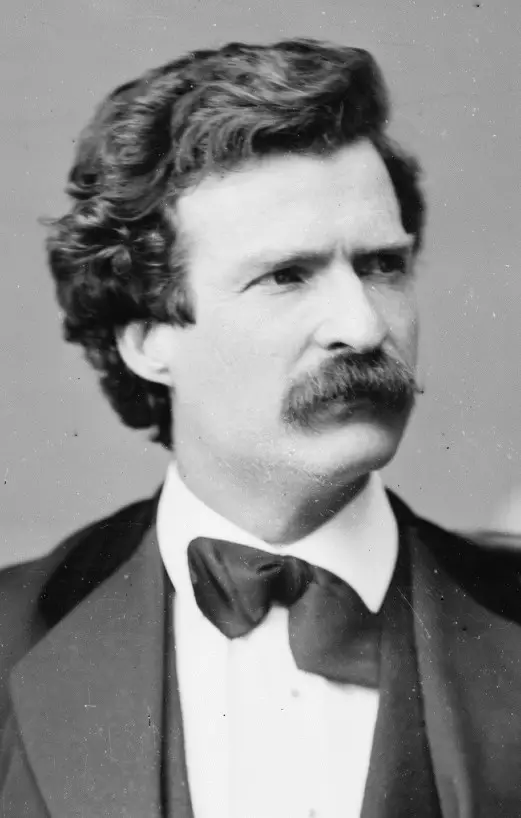
Text: Europe and Elsewhere (1923), “Corn-pone Opinions”, Mark Twain (written 1900, published 1923), https://en.wikipedia.org/wiki/Mark_Twain · Public domain (https://creativecommons.org/publicdomain/mark/1.0/) · shortened · Picture: Mathew Brady (Brady-Handy studio), Public domain (https://creativecommons.org/publicdomain/mark/1.0/), https://commons.wikimedia.org/wiki/File:Mark_Twain,_Brady-Handy_photo_portrait,_Feb_7,_1871,_cropped.jpg · Translations: English Wiktionary contributors, CC BY-SA 4.0 (https://creativecommons.org/licenses/by-sa/4.0/) · Worksheet: https://krumeto.com/read/corn-pone-opinions
A. Choose the right answer
- What is Twain's main argument? C2
- a) Independent thinking is common but usually hidden.
- b) Women follow fashion more closely than men.
- c) Fashions change because designers study what people need.
- d) Most of our opinions come from wanting approval, not from reasoning.
- What is the effect of "Was the resentment reasoned out? Was the acceptance reasoned out? No."? C2
- a) It praises the public for changing its mind.
- b) It mocks the idea that public opinion is the result of thought.
- c) It invites the reader to research the history of fashion.
- d) It shows that Twain is unsure of the answer.
- Why does even the woman who refuses the hoopskirt "come under that law"? C2
- a) She later starts a new fashion herself.
- b) A real law forces her to wear it.
- c) Her refusal is also driven by her need for self-approval.
- d) She secretly wears it at home.
- According to Twain, where does our self-approval usually come from? C1
- a) Religious teaching
- b) Careful study of the facts
- c) The approval of other people
- d) Our childhood memories
- What does the contrast between "an empress" and "a nobody" show? C2
- a) Bloomers were more practical than hoopskirts.
- b) People always prefer simple clothes.
- c) A new fashion's success depends on the status of the person who starts it.
- d) Only royalty may wear new styles.
- In paragraph 2, "to train with the multitude" most nearly means… C1
- a) to exercise in large groups
- b) to teach crowds of people
- c) to go along with what most people do
- d) to travel with many others
- How would you describe the tone of the excerpt? C2
- a) Angry and bitter throughout
- b) Formal and strictly scientific
- c) Sentimental and nostalgic
- d) Dry and ironic, with a serious point underneath
B. Answer in full sentences
- The title comes from a saying Twain heard as a boy: tell me where a man gets his corn pone (his bread), and I will tell you his opinions. How does the excerpt develop this idea?
- Think of a trend — clothes, an app, a phrase — that first seemed strange and is now normal. Did you "reason it out", or did you conform?
Answer key
- d) Most of our opinions come from wanting approval, not from reasoning. — Paragraphs 1–2: a reasoned, independent verdict is "a most rare thing"; "the instinct that moves to conformity did the work."
- b) It mocks the idea that public opinion is the result of thought. — Paragraph 2: the short questions and the blunt "No." dismiss reasoning as the cause of either reaction.
- c) Her refusal is also driven by her need for self-approval. — Paragraph 2: "she could not wear the skirt and have her own approval; and that she must have".
- c) The approval of other people — Paragraph 2: "our self-approval has its source in but one place… the approval of other people."
- c) A new fashion's success depends on the status of the person who starts it. — Paragraph 2: people yield "to that vague something recognized as authority" — the empress's hoopskirt spread, the nobody's bloomer did not.
- c) to go along with what most people do — Paragraph 2: it is paired with "have its approval" — joining the crowd to be approved of.
- d) Dry and ironic, with a serious point underneath — Paragraph 3: "no one knows how nor why; nor cares, for that matter. It will come again, by and by" — light, ironic, but the claim about conformity is serious.
Text: Europe and Elsewhere (1923), “Corn-pone Opinions”, Mark Twain (written 1900, published 1923), https://en.wikipedia.org/wiki/Mark_Twain · Public domain (https://creativecommons.org/publicdomain/mark/1.0/) · shortened · Picture: Mathew Brady (Brady-Handy studio), Public domain (https://creativecommons.org/publicdomain/mark/1.0/), https://commons.wikimedia.org/wiki/File:Mark_Twain,_Brady-Handy_photo_portrait,_Feb_7,_1871,_cropped.jpg · Translations: English Wiktionary contributors, CC BY-SA 4.0 (https://creativecommons.org/licenses/by-sa/4.0/) · Worksheet: https://krumeto.com/read/corn-pone-opinions