Inflation
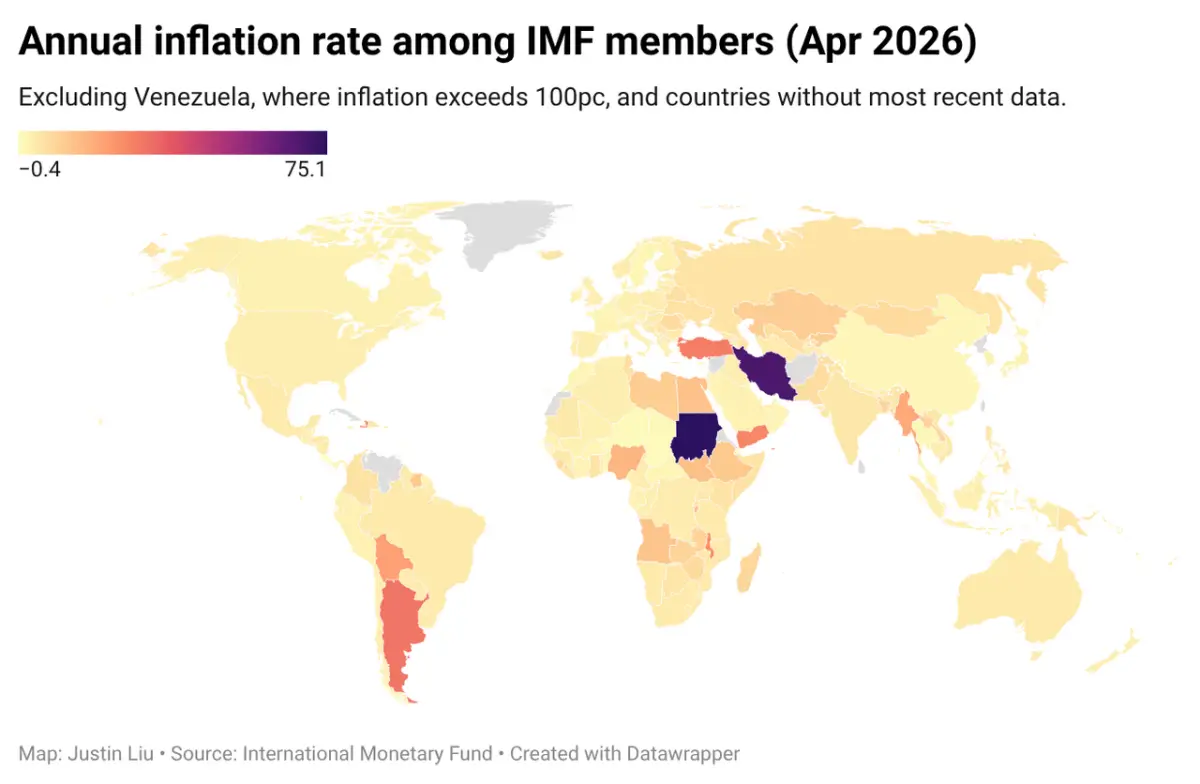
- In economics, inflation is an increase in the average price of goods and services in terms of money, though it originally referred to the increase of the money supply (monetary inflation) that can cause such a universal shift. This increase is measured using a price index, typically a consumer price index (CPI). When the general price level rises, each unit of currency buys fewer goods and services; consequently, inflation corresponds to a reduction in the purchasing power of money. The opposite of inflation is deflation, a decrease in the general price level of goods and services. The common measure of inflation is the inflation rate, the annualized percentage change in a general price index.
- Changes in inflation are widely attributed to increases in the money supply, fluctuations in real demand for goods and services (also known as demand shocks, including changes in fiscal or monetary policy), changes in available supplies such as during energy crises (also known as supply shocks), significant decreases in interest rates set by the central bank, or changes in inflation expectations, which may be self-fulfilling.
- Moderate inflation affects economies in both positive and negative ways. The negative effects would include an increase in the opportunity cost of holding money; incentivizing workers to switch jobs unnecessarily, making labor markets appear tight while average real wages fall; forcing workers into risky wage negotiations to keep pace, as purchasing power erodes between contracts; uncertainty over future inflation, which may discourage investment and savings; and, if inflation were rapid enough, shortages of goods as consumers begin hoarding out of concern that prices will increase in the future. Positive effects include reducing unemployment due to nominal wage rigidity,allowing the central bank greater freedom in carrying out monetary policy, encouraging loans and investment instead of money hoarding, and avoiding the inefficiencies associated with deflation.
- Today, most economists favour a low and steady rate of inflation. Low (as opposed to zero or negative) inflation reduces the likelihood of economic recessions by enabling the labor market to adjust more quickly and reduces the risk that a liquidity trap prevents monetary policy from stabilizing the economy, while also avoiding the costs associated with high inflation. The task of keeping the rate of inflation low and stable is usually given to central banks that control monetary policy, normally through the setting of interest rates and by carrying out open market operations.
Words to know
- monetary
- relating to money, especially how much exists — finanziell, geldlich, pekuniär — monetario — monétaire — monetario — walutowy, pieniężny — monetário — денежный, валютный — parasal — валютний, грошовий, грошевий
- index B2
- a number that shows changes in prices — Index, Verzeichnis — índice — index — indice — spis — índice — указатель, индекс — endeks — індекс
- purchase B2
- buying — kaufen, erwerben, erstehen — comprar, mercar — acheter, acquérir — acquistare — nabyć — comprar — покупать, приобретать
- deflation
- a general fall in prices
- fluctuation C2
- frequent changes up and down — Fluktuation — fluctuación — fluctuation — wahanie — flutuação — колебание, неустойчивость — dalgalanma — коливання, флуктуація
- fiscal B2
- relating to government taxes and spending — fiscal, crematístico — budgétaire — fiscale — fiscal — фискальный, финансовый — фіскальний, фінансовий
- incentivize
- giving people a reason to do something — begünstigen, Anreize schaffen, belohnen — incentivar
- erode
- slowly becomes smaller or weaker — erodieren — erosionar — éroder — erodere — erodir — эродировать — еродувати
- hoard
- collecting and keeping large amounts of something — horten — acaparar — accumuler, amasser, thésauriser — accumulare — gromadzić — acumular — копить, запасать, запасти
- recession B2
- periods when the economy shrinks — Rezession — recesión — récession — recessione — recesja — recessão — рецессия, спад — resesyon — спад, рецесія
Text: English Wikipedia, “Inflation”, Wikipedia contributors, https://en.wikipedia.org/wiki/Inflation · CC BY-SA 4.0 (https://creativecommons.org/licenses/by-sa/4.0/) · shortened · Picture: JJLiu112, CC0 1.0 (https://creativecommons.org/publicdomain/zero/1.0/), https://commons.wikimedia.org/wiki/File:World_inflation_rate.png · Translations: English Wiktionary contributors, CC BY-SA 4.0 (https://creativecommons.org/licenses/by-sa/4.0/) · Worksheet: https://krumeto.com/read/inflation
A. Choose the right answer
- What did the word "inflation" originally refer to? C1
- a) An increase in the average price of goods
- b) A decrease in the general price level
- c) An increase in the money supply
- d) A rise in interest rates
- If inflation is high, what happens to the value of a 10-euro note? C2
- a) It buys fewer goods and services than before.
- b) It buys the same, because wages rise too.
- c) It becomes part of the money supply again.
- d) It buys more goods and services than before.
- Which of these is described as a "supply shock"? C1
- a) A change in government fiscal policy
- b) A sudden fall in central bank interest rates
- c) A change in people's inflation expectations
- d) An energy crisis that reduces available supplies
- Which is given as a NEGATIVE effect of moderate inflation? C1
- a) Unemployment falls because wages are rigid.
- b) The central bank has more freedom.
- c) Workers may change jobs when there is no real need.
- d) People take loans and invest instead of hoarding money.
- Why might consumers start hoarding goods when inflation is rapid? C2
- a) Their wages are rising faster than prices.
- b) They want to cause deflation.
- c) They expect prices to rise further.
- d) The central bank tells them to.
- What kind of inflation do most economists prefer today? C1
- a) Zero
- b) High but predictable
- c) Low and steady
- d) Negative
- How do central banks usually keep inflation low and stable? C1
- a) By controlling workers' wages directly
- b) By printing more money when prices rise
- c) By fixing the prices of most goods by law
- d) By setting interest rates, among other tools
B. Answer in full sentences
- Have the prices of things you buy changed recently? Give examples and explain how this affects you.
- Should central banks aim for zero inflation instead of low inflation? Argue one side, using the text.
Answer key
- c) An increase in the money supply — Paragraph 1 says it originally referred to the increase of the money supply.
- a) It buys fewer goods and services than before. — Paragraph 1 says that when prices rise, each unit of currency buys fewer goods and services.
- d) An energy crisis that reduces available supplies — Paragraph 2 calls changes in available supplies, such as energy crises, supply shocks.
- c) Workers may change jobs when there is no real need. — Paragraph 3 lists incentivising workers to switch jobs unnecessarily as a negative effect; the others are positive.
- c) They expect prices to rise further. — Paragraph 3 says consumers hoard out of concern that prices will increase in the future.
- c) Low and steady — Paragraph 4 says most economists favour a low and steady rate of inflation.
- d) By setting interest rates, among other tools — The last sentence of paragraph 4 describes interest rates and open market operations.
Text: English Wikipedia, “Inflation”, Wikipedia contributors, https://en.wikipedia.org/wiki/Inflation · CC BY-SA 4.0 (https://creativecommons.org/licenses/by-sa/4.0/) · shortened · Picture: JJLiu112, CC0 1.0 (https://creativecommons.org/publicdomain/zero/1.0/), https://commons.wikimedia.org/wiki/File:World_inflation_rate.png · Translations: English Wiktionary contributors, CC BY-SA 4.0 (https://creativecommons.org/licenses/by-sa/4.0/) · Worksheet: https://krumeto.com/read/inflation