20-year-old astrophotographer captures rare solar eclipse on Saturn
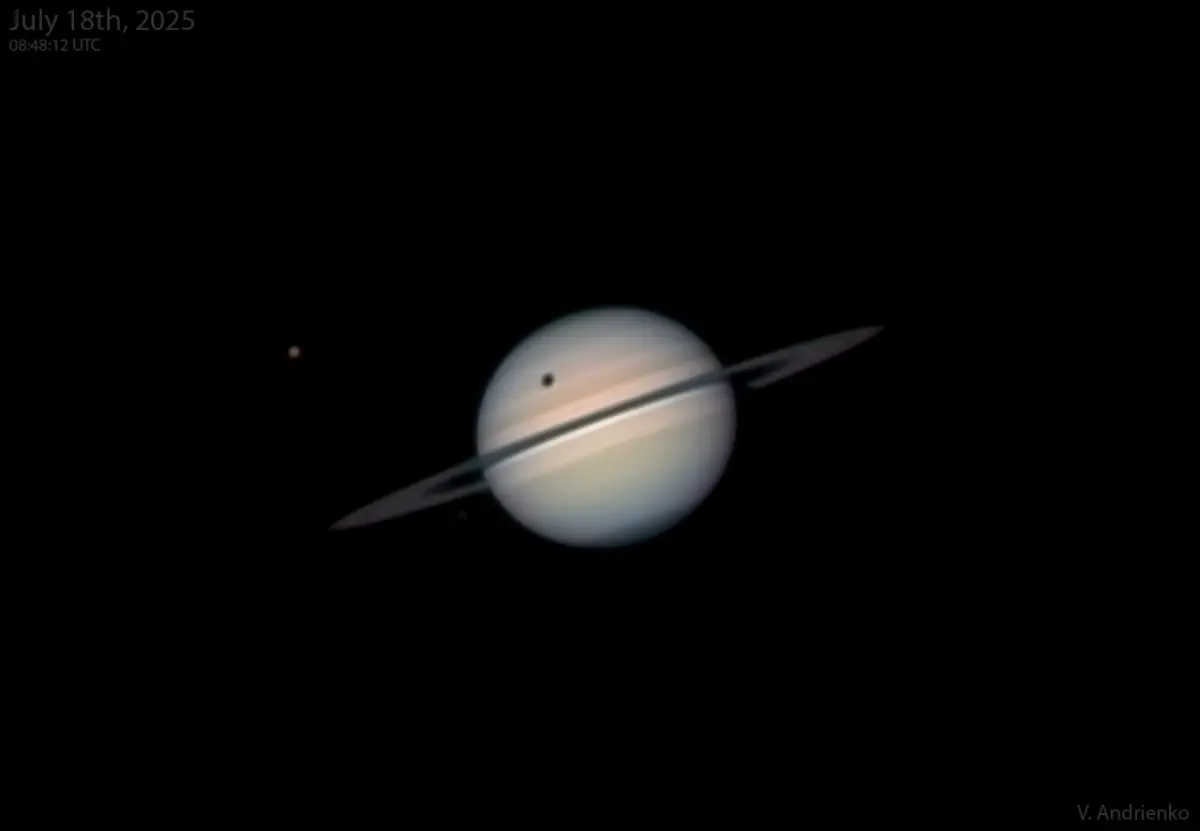
- A 20-year-old astrophotographer from Shoreline, Washington has photographed a rare solar eclipse on Saturn from his hometown, an event that will not be seen again until 2038. The photographer, Adam Smadi, planned the image days ahead and took the image on June 1, using the Stellarium software to pinpoint when Saturn's largest moon, Titan, would cast a shadow across the planet's surface.
- Smadi set up his 9.25-inch telescope at about 1 a.m. PDT (08:00 UTC) so the optics could cool to the outdoor temperature. This step helps prevent air currents inside the telescope tube that can blur images. By 3:30 a.m. PDT (10:30 UTC), Saturn was high enough above the horizon to begin taking photos.
- He used a ZWO ASI662MC astrophotography camera with an infrared filter. He took continuous video clips, then used software to sort and combine thousands of sharp frames into a single image.
- The result shows Titan's small dark shadow crossing Saturn's pale surface. In the same view, three other moons, Dione, Tethys, and Enceladus, appear as tiny dots near the rings.
- Adam Smadi initially shared the photos on his Instagram. Some viewers from forums and social media praised the image for its clarity and the effort behind it.
Words to know
- astrophotographer
- a person who takes photos of stars and planets
- eclipse
- when one object in space blocks the sun's light — Sonnenfinsternis, Finsternis, Mondfinsternis — eclipse, eclipsi — éclipse — eclissi, eclisse — zaćmienie — eclipse — затмение — tutulma — затемнення
- pinpoint
- find out exactly — genau verorten, ausmitteln — identifier, localiser
- cast B2
- make a shadow appear on something — werfen — jeter — gettare — miotać, ciskać, cisnąć — arremessar, tacar — бросать, бросить, кинуть — кинути, кидати, залишати
- telescope B2
- an instrument that makes distant things look closer — Teleskop, Fernrohr — telescopio — télescope — telescopio — teleskop — telescópio — телескоп — teleskop — телескоп, далекогляд
- optics
- the lenses and mirrors inside a telescope — Optik — óptica — ottica — optyka — óptica — оптика — оптика
- blur B2
- make something look unclear — verwischen, verschmieren — difuminar — brouiller — sbavare — rozmazywać, mazać — desfocar — размазать — розтерти
- horizon B1
- the line where the sky seems to meet the land — Horizont — horizonte — horizon — orizzonte — horyzont — horizonte — горизонт — ufuk — горизонт, овид, обрій
- frame A2
- single pictures that together make a video — Rahmen, Gerüst — armazón — cadre — telaio, impalcatura — rama — estrutura, armação — каркас, рама, ферма — iskelet — каркас, рама, остов
- clarity
- the quality of being clear and sharp — Klarheit — claridad — clarté — chiarezza — klarowność — clareza, claridade — ясность — ясність
Text: Wikinews, “20-year-old astrophotographer captures rare solar eclipse on Saturn”, https://en.wikinews.org/wiki/20-year-old_astrophotographer_captures_rare_solar_eclipse_on_Saturn · CC BY 4.0 (https://creativecommons.org/licenses/by/4.0/) · shortened · Picture: Volodymyr Andrienko, CC BY 4.0 (https://creativecommons.org/licenses/by/4.0/), https://commons.wikimedia.org/wiki/File:Titan_Shadow_Transit_on_July_18th,_2025.png · Translations: English Wiktionary contributors, CC BY-SA 4.0 (https://creativecommons.org/licenses/by-sa/4.0/) · Worksheet: https://krumeto.com/read/solar-eclipse-on-saturn
A. Choose the right answer
- When will this kind of eclipse be seen again? B1
- a) In 2038
- b) In 2083
- c) Next June
- d) Every twenty years
- What did Smadi use the Stellarium software for? B1
- a) To share the finished photos with viewers on Instagram
- b) To find out exactly when Titan's shadow would cross Saturn
- c) To combine thousands of frames into one image
- d) To cool the telescope to the outdoor temperature
- Why did Smadi set up his telescope at 1 a.m. but start taking photos later? B2
- a) Titan's shadow can only be seen after 3:30 a.m.
- b) The optics needed to cool, and Saturn to rise higher.
- c) He had to wait for the Sun to rise first.
- d) His camera batteries needed hours to charge.
- What problem does cooling the optics help to prevent? B1
- a) Damage to the infrared filter
- b) The telescope getting too cold to work
- c) Light from the city reaching the camera
- d) Air currents in the tube that blur the images
- How did he make the final image? B1
- a) He used pictures sent back by a space probe.
- b) He took one long photo through the telescope.
- c) He combined thousands of sharp frames from video clips.
- d) He drew the shadow onto an older photo of Saturn.
- What does the image show near Saturn's rings? B1
- a) A comet passing the planet
- b) The Sun behind Saturn
- c) Three other moons as tiny dots
- d) Titan's large bright shadow
- In paragraph 5, people praised the image for its "clarity". They liked that it was… B1
- a) taken from far away
- b) sharp and easy to see
- c) full of colour
- d) very large
B. Answer in full sentences
- Smadi planned for days to take one picture. Write about something you prepared carefully for and how it went.
- Should amateur scientists and photographers get more attention for their work? Discuss.
Answer key
- a) In 2038 — Paragraph 1 says the event will not be seen again until 2038.
- b) To find out exactly when Titan's shadow would cross Saturn — Paragraph 1 says he used Stellarium to pinpoint when Titan would cast a shadow across the planet.
- b) The optics needed to cool, and Saturn to rise higher. — Paragraph 2: he set up early so the optics could cool, and at 3:30 a.m. Saturn was high enough above the horizon.
- d) Air currents in the tube that blur the images — Paragraph 2 says cooling prevents air currents inside the telescope tube that can blur images.
- c) He combined thousands of sharp frames from video clips. — Paragraph 3 says he took video clips and used software to combine thousands of sharp frames.
- c) Three other moons as tiny dots — Paragraph 4 says Dione, Tethys and Enceladus appear as tiny dots near the rings.
- b) sharp and easy to see — Paragraph 5 praises the clarity of the image, meaning it is clear and sharp.
Text: Wikinews, “20-year-old astrophotographer captures rare solar eclipse on Saturn”, https://en.wikinews.org/wiki/20-year-old_astrophotographer_captures_rare_solar_eclipse_on_Saturn · CC BY 4.0 (https://creativecommons.org/licenses/by/4.0/) · shortened · Picture: Volodymyr Andrienko, CC BY 4.0 (https://creativecommons.org/licenses/by/4.0/), https://commons.wikimedia.org/wiki/File:Titan_Shadow_Transit_on_July_18th,_2025.png · Translations: English Wiktionary contributors, CC BY-SA 4.0 (https://creativecommons.org/licenses/by-sa/4.0/) · Worksheet: https://krumeto.com/read/solar-eclipse-on-saturn