Weather
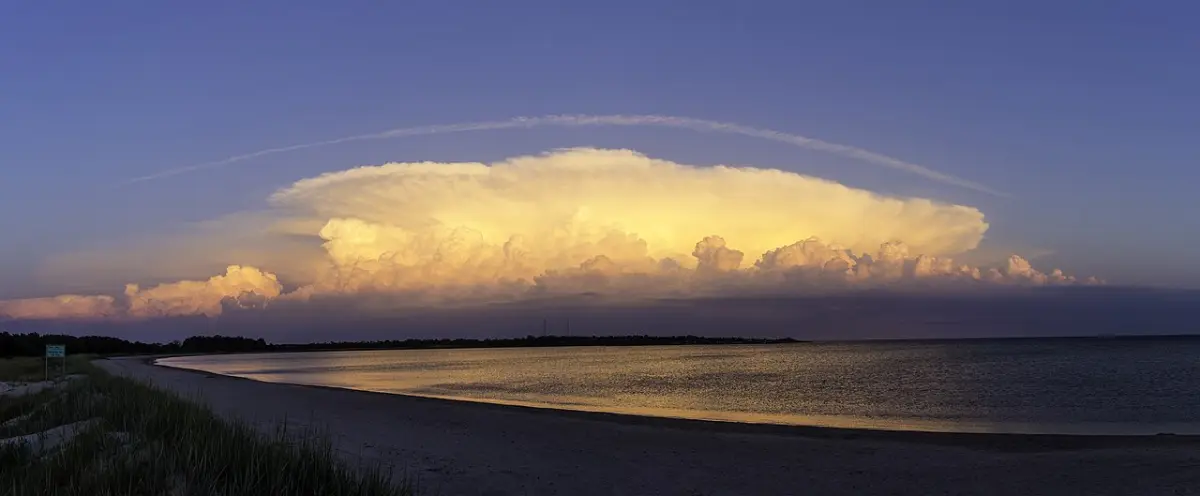
- Weather is the day-to-day or hour-to-hour change in the atmosphere. Weather includes wind, lightning, storms, hurricanes, tornadoes, rain, hail, snow, and lots more. Energy from the Sun affects the weather too.
- Climate tells us what kinds of weather usually happen in an area at different times of the year.
- Changes in weather can affect the mood and life of many living things. People wear different clothes and do different things in different weather conditions. They also choose different food in different seasons.
- Weather stations around the world measure different parts of weather. Ways to measure weather are wind speed, wind direction, temperature and humidity. People try to use these measurements to make weather forecasts for the future. These people are scientists that are called meteorologists. They use computers to build large mathematical models to follow weather trends.
- Weather happens because different parts of the Earth get different amounts of heat from the Sun. This makes different climates. The tropics get the most heat because the Sun shines straight down on them, while the poles get the least heat because the Sun shines on them from a low angle. Warmer air is lighter than cooler air and rises higher in the sky by convection.
- The air always has some water mixed with it. This is called humidity. When it cools, the water can change from a gas to a liquid through condensation. Then the water can fall from the sky as rain or snow. After the air rises, it gets colder and goes back towards the ground. Because the air lost its water before, it is dry when it comes back to the ground. When two air masses of different temperatures meet, this is called a warm front or cold front. The ways that the air moves around the Earth are called atmospheric circulation.
Words to know
- atmosphere B1
- the air around the Earth — Atmosphäre — atmósfera, aire — atmosphère — atmosfera — atmosfera — atmosfera — атмосфера, воздух — atmosfer — атмосфера
- hurricane
- violent storms with very strong winds — Orkan, Hurrikan, Hurrikane — huracán — ouragan — uragano — huragan — furacão — ураган — kasırga — ураган
- hail B2
- small balls of ice that fall like rain — Hagel — granizo — grêle — grandine — grad — granizo — град — dolu — град
- mood A2
- the way you feel at a particular time — Laune, schlechte Laune, Stimmung — mal humor, estado de ánimo — humeur, mauvaise humeur — umore, cattivo umore — humor, nastrój — humor, mau humor — настроение, дурное настроение, расположение — настрій
- humidity
- the amount of water in the air — Feuchtigkeit, Luftfeuchtigkeit — humedad — humidité — umidità — wilgotność — umidade, humidade — влажность — nem — вологість
- forecast B1
- statements about what the weather will be — Prognose, Vorhersage — pronóstico — prévision — previsione — zapowiedź, prognoza — previsão — прогноз, предсказание, предвидение — tahmin — прогноз, передбачення
- meteorologist
- scientists who study the weather — Meteorologe — meteorólogo — météorologue — meteorologo — meteorolog — meteorologista — метеоролог
- convection
- the rising of warm air or liquid — convection — convezione — konwekcja — convecção — конвекция — конвекція
- condensation C2
- the change of a gas into a liquid — Kondensation — condensación — condensation — condensazione — kondensacja — condensação — уплотнение, сгущение
- circulation C1
- movement around and around a system — Blutkreislauf — circulación — circulation — circolazione — circulação — кровообращение — dolaşım, kan dolaşımı, sirkülasyon — кровообіг
Text: Simple English Wikipedia, “Weather”, Wikipedia contributors, https://simple.wikipedia.org/wiki/Weather · CC BY-SA 4.0 (https://creativecommons.org/licenses/by-sa/4.0/) · shortened · Picture: Bene Riobó, CC BY-SA 4.0 (https://creativecommons.org/licenses/by-sa/4.0/), https://commons.wikimedia.org/wiki/File:Cumulonimbus_en_Gotland.jpg · Translations: English Wiktionary contributors, CC BY-SA 4.0 (https://creativecommons.org/licenses/by-sa/4.0/) · Worksheet: https://krumeto.com/read/weather
A. Choose the right answer
- What is the difference between weather and climate? A2
- a) Weather is about wind; climate is about rain and snow.
- b) Climate changes every hour; weather changes once a year.
- c) Weather is measured by stations; climate cannot be measured.
- d) Weather is daily change; climate is an area's usual weather.
- Which of these is NOT given as a way to measure weather in paragraph 4? A2
- a) Wind direction
- b) Humidity
- c) The colour of clouds
- d) Temperature
- What do meteorologists use computers for? A2
- a) To build mathematical models that follow weather trends
- b) To decide which clothes people should wear each day
- c) To change the speed and direction of the wind
- d) To control the amount of humidity in the air
- Why do the poles get the least heat? B1
- a) The Sun shines on them from a low angle.
- b) Warm air always rises away from them.
- c) They have the most water in the air.
- d) They are far from any weather station.
- What happens to warm air, according to paragraph 5? A2
- a) It loses all of its heat over the tropics.
- b) It changes into rain or snow straight away.
- c) It is heavier than cool air and sinks to the ground.
- d) It is lighter than cool air and rises by convection.
- Put the steps of paragraph 6 in order: (a) water falls as rain or snow, (b) the air cools and the water becomes liquid, (c) dry air comes back down to the ground. A2
- a) b – c – a
- b) c – b – a
- c) b – a – c
- d) a – b – c
- What is it called when two air masses of different temperatures meet? A2
- a) Condensation
- b) Atmospheric circulation
- c) Convection
- d) A warm front or a cold front
B. Answer in full sentences
- How does the weather change your mood or your plans? Give two examples from your life.
- Weather forecasts are sometimes wrong. Why do you think the weather is hard to predict?
Answer key
- d) Weather is daily change; climate is an area's usual weather. — Paragraph 1 defines weather as day-to-day change; paragraph 2 says climate tells us what weather usually happens in an area.
- c) The colour of clouds — Paragraph 4 lists wind speed, wind direction, temperature and humidity.
- a) To build mathematical models that follow weather trends — Paragraph 4 says meteorologists use computers to build large mathematical models.
- a) The Sun shines on them from a low angle. — Paragraph 5 says the poles get the least heat because the Sun shines on them from a low angle.
- d) It is lighter than cool air and rises by convection. — Paragraph 5 says warmer air is lighter than cooler air and rises higher by convection.
- c) b – a – c — Paragraph 6: the water condenses when the air cools, then falls as rain or snow, then the dry air returns to the ground.
- d) A warm front or a cold front — Paragraph 6 says this is called a warm front or cold front.
Text: Simple English Wikipedia, “Weather”, Wikipedia contributors, https://simple.wikipedia.org/wiki/Weather · CC BY-SA 4.0 (https://creativecommons.org/licenses/by-sa/4.0/) · shortened · Picture: Bene Riobó, CC BY-SA 4.0 (https://creativecommons.org/licenses/by-sa/4.0/), https://commons.wikimedia.org/wiki/File:Cumulonimbus_en_Gotland.jpg · Translations: English Wiktionary contributors, CC BY-SA 4.0 (https://creativecommons.org/licenses/by-sa/4.0/) · Worksheet: https://krumeto.com/read/weather