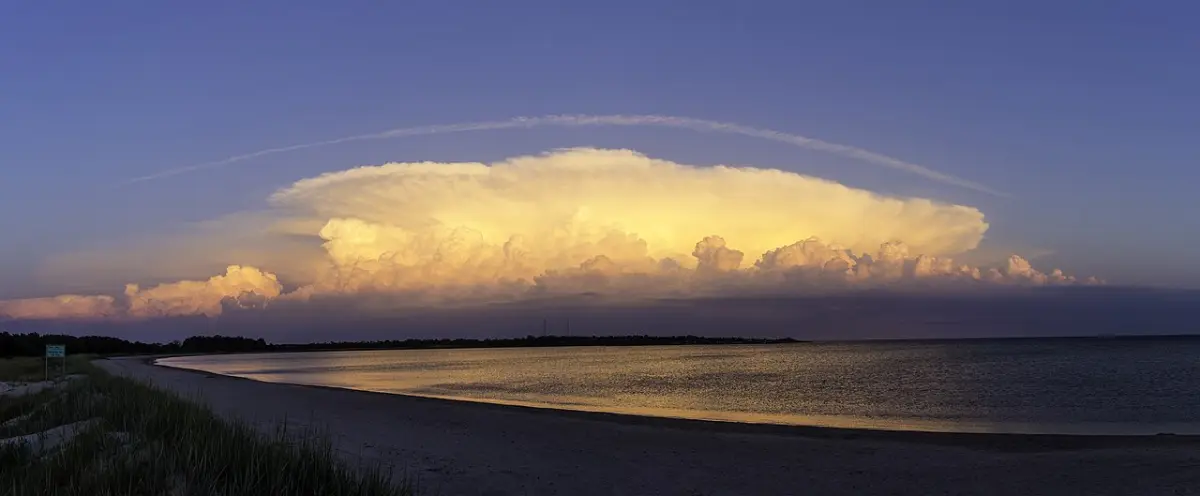
Weather is the day-to-day or hour-to-hour change in the atmosphere. Weather includes wind, lightning, storms, hurricanes, tornadoes, rain, hail, snow, and lots more. Energy from the Sun affects the weather too.
Climate tells us what kinds of weather usually happen in an area at different times of the year.
Changes in weather can affect the mood and life of many living things. People wear different clothes and do different things in different weather conditions. They also choose different food in different seasons.
Weather stations around the world measure different parts of weather. Ways to measure weather are wind speed, wind direction, temperature and humidity. People try to use these measurements to make weather forecasts for the future. These people are scientists that are called meteorologists. They use computers to build large mathematical models to follow weather trends.
Weather happens because different parts of the Earth get different amounts of heat from the Sun. This makes different climates. The tropics get the most heat because the Sun shines straight down on them, while the poles get the least heat because the Sun shines on them from a low angle. Warmer air is lighter than cooler air and rises higher in the sky by convection.
The air always has some water mixed with it. This is called humidity. When it cools, the water can change from a gas to a liquid through condensation. Then the water can fall from the sky as rain or snow. After the air rises, it gets colder and goes back towards the ground. Because the air lost its water before, it is dry when it comes back to the ground. When two air masses of different temperatures meet, this is called a warm front or cold front. The ways that the air moves around the Earth are called atmospheric circulation.